
AI-assisted content creation?
Capture your creative potential.
What is AI-assisted content creation?
AI-assisted content creation is the process of creating written content with the support of artificial intelligence and large language models, often called LLMs. Tools like ChatGPT are well-known examples, but they are only one type of AI engine. In practice, there are many different models, each suited to different tasks, languages, and levels of complexity.
At its core, AI-assisted content creation means using AI engines and tools to generate text, structure ideas, analyse existing content, or prepare drafts. The goal is not to replace human writers, but to support them, because ideally all generated output is checked, edited or validated. AI helps speed up the process, while humans remain responsible for meaning, tone, accuracy, and purpose.
This approach allows teams to create content more efficiently, especially when working across multiple languages or markets.



Why AI content creation needs human guidance
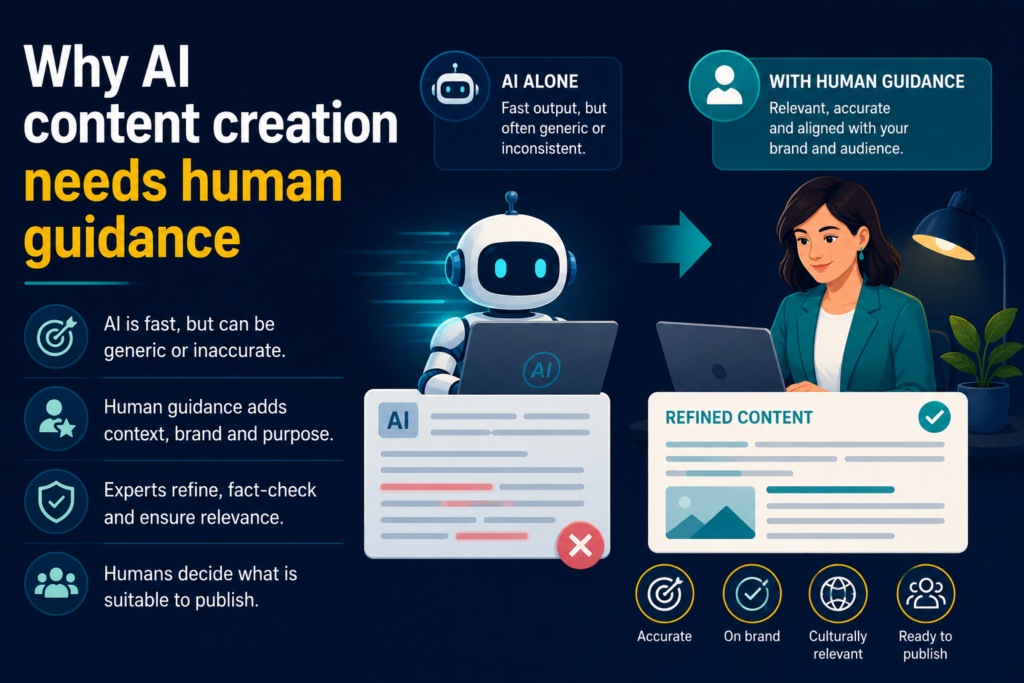
AI content creation can produce large volumes of text in seconds. This is one of its biggest advantages. At the same time, AI-generated content is often generic, inconsistent, or inaccurate if it is used without guidance. It often does not understand your brand, your audience, or the real-world consequences of what it writes or can generate nonsense (hallucination). This is where human guidance becomes essential. By prompting AI in the right way, with clear context, brand rules, tone guidelines, and intent, content becomes more relevant, more creative, and more accurate. Human specialists steer the AI, refine the output, and decide what is suitable to publish.
Creating content directly in the target language
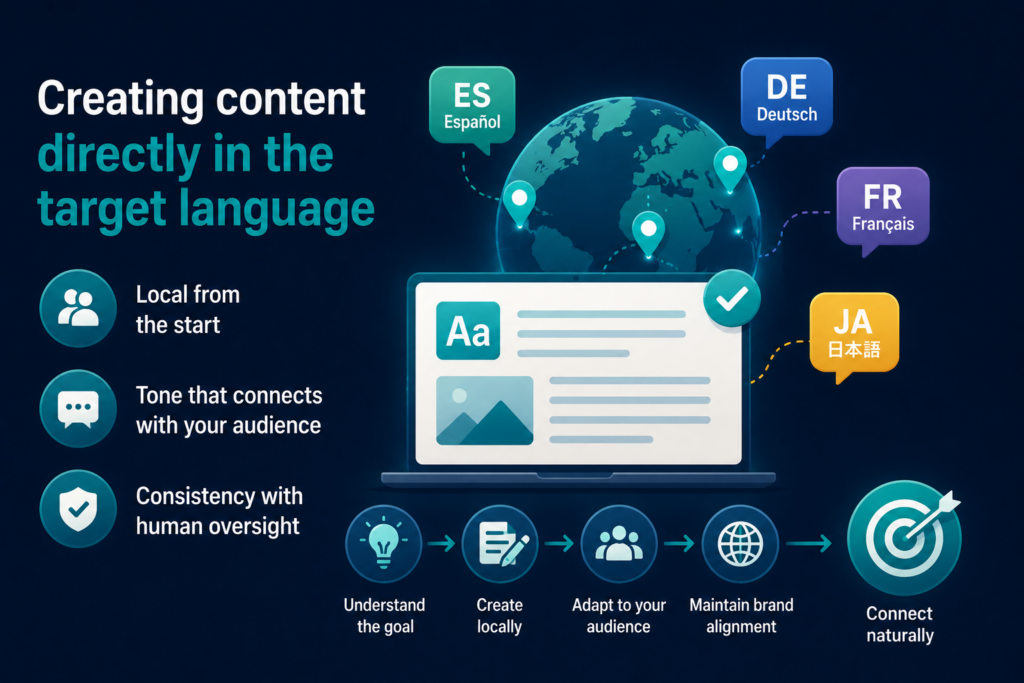
One of the possibilities of AI-assisted content creation is to create content directly in the target language, with the local audience in mind from the start. This gives you more freedom to incorporate local tone, cultural references, preferences and communication styles, helping the content connect naturally with its intended audience.
However, this approach requires careful localization management. When content is created separately for different markets, there is more room for local variation, which can cause messages to move further away from the centrally defined brand message. Clear briefings, terminology, style guidelines and human oversight are therefore essential to maintain consistency across markets.
For content where close alignment with the original message is the priority, translation may still be the better approach. For content where local relevance and creative freedom matter more, creating directly in the target language can be a powerful alternative. The right approach depends on the content, audience and communication goal.
Use case examples
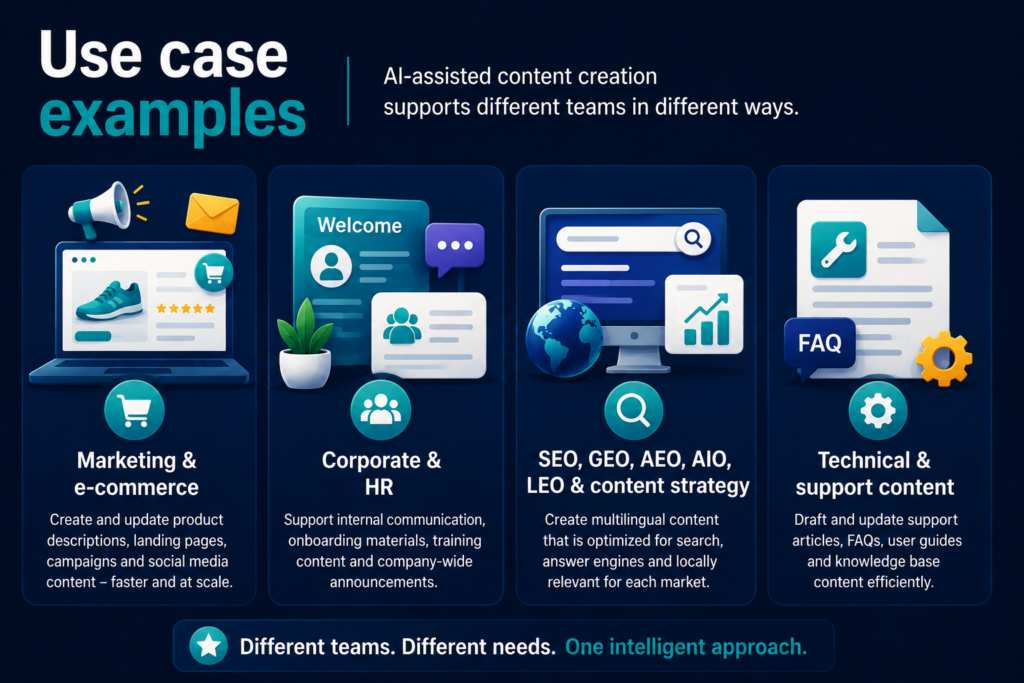
AI-assisted content creation supports different teams in different ways.
Marketing and e-commerce
Marketing and e-commerce teams often need to create and update large volumes of content, from product descriptions and landing pages to campaign copy, emails and social media content. AI-assisted content creation speeds up this process by generating first versions based on your briefing, brand voice, terminology and existing content. Human specialists then refine and validate the output. This makes it possible to produce and update more content in less time, while keeping it accurate, consistent and relevant to the audience.
Corporate and HR
Corporate communication teams use AI to support more effective internal communication, multilingual onboarding materials, training content, and company-wide announcements. Content needs to be clear, neutral, and aligned across regions.
SEO, GEO, AEO, AIO, LEO and content strategy
Search visibility is changing. Traditional SEO remains important, but people increasingly discover information through AI systems and answer engines as well. AI-assisted content creation can help teams create multilingual content that is structured and optimized for SEO, GEO, AEO, AIO and LEO. This can include keyword-driven articles, content briefs, FAQs, answer-focused content and locally relevant content for different markets. Human specialists guide the process to ensure the content remains useful, accurate and relevant to the intended audience, rather than being created purely for search engines or AI systems.
Technical and support content
Technical teams use AI to help structure and draft support articles, FAQs, user guides, and knowledge base content. This is especially useful when documentation needs frequent updates across languages.
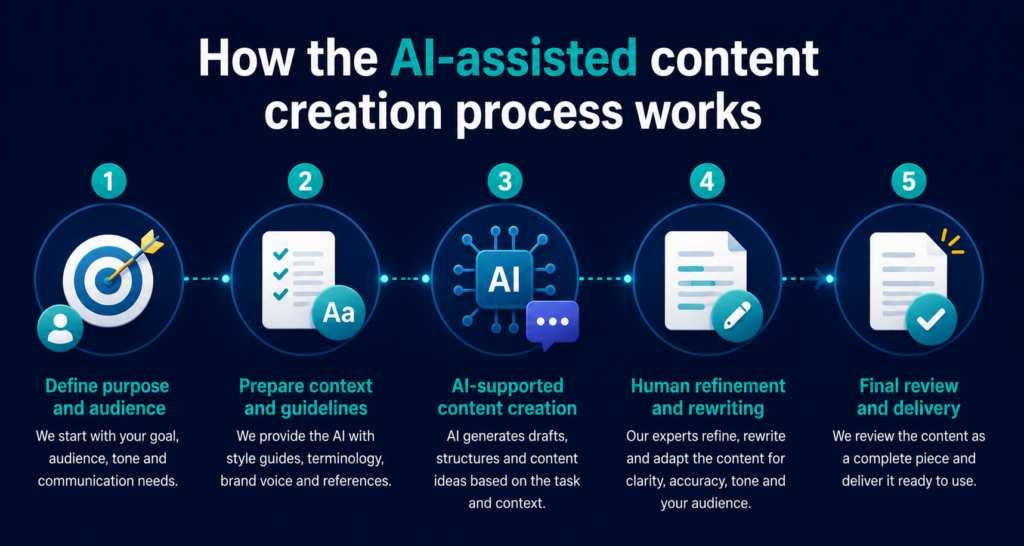
How the AI-assisted content creation process works
- Defining purpose and audience
The starting point is always the goal of the content. Who is it for? What should it achieve? What tone and style are required? - Preparing context and guidelines
Style guides, terminology, brand voice, and reference material are defined and prepared so the AI has clear direction. - AI-supported content creation
AI generates drafts, structures, or content suggestions based on the defined context and task. - Human refinement and rewriting
Experienced linguists and content specialists refine the text. They adjust tone, improve clarity, correct inaccuracies, and ensure the message works for the intended audience. - Final review and delivery
The content is reviewed as a complete piece and delivered ready for use in its intended channel.
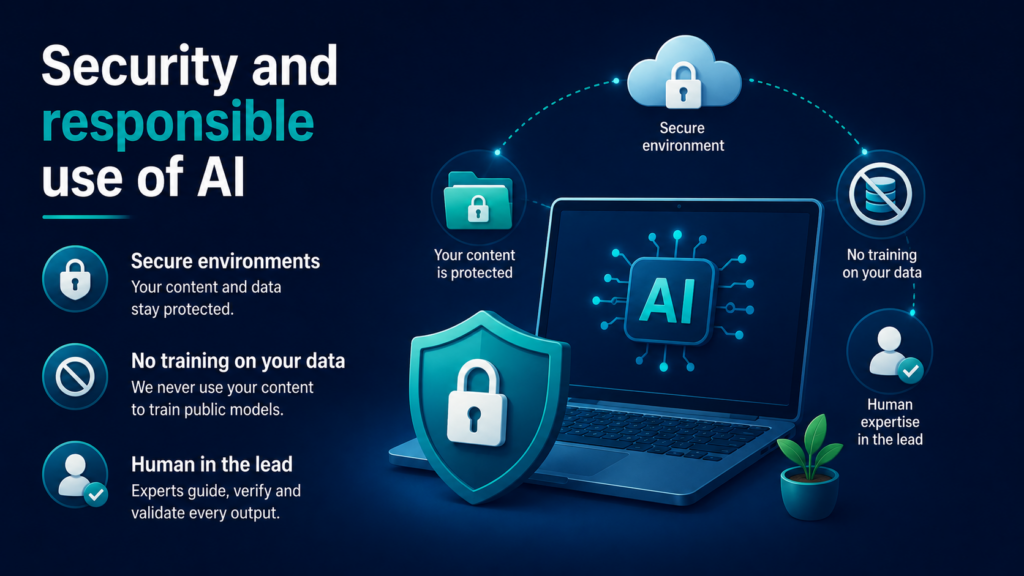
Security and responsible use of AI
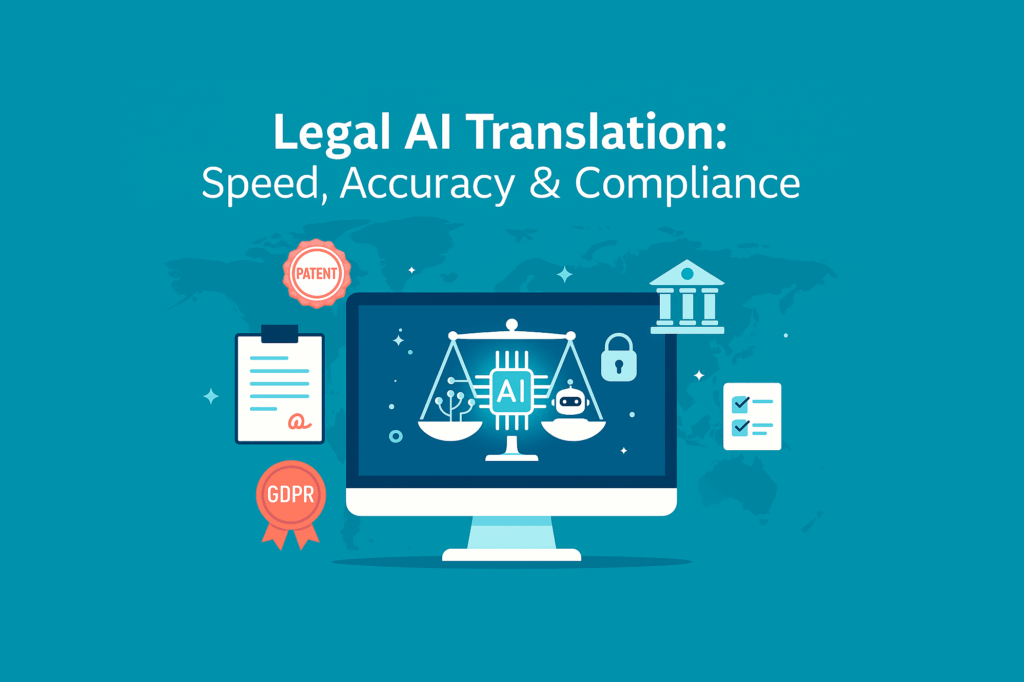
AI-assisted content creation must be handled responsibly. Professional use requires controlled and secure environments where content and data remain protected. This is especially important when working with proprietary information, brand material, or internal communication. Public, free AI tools do not guarantee that prompts, documents, or generated content remain private, which can create real risks in marketing, legal, or corporate contexts. Using secure AI environments ensures that content is generated safely, responsibly, and without exposing sensitive data or relying on uncontrolled tools.
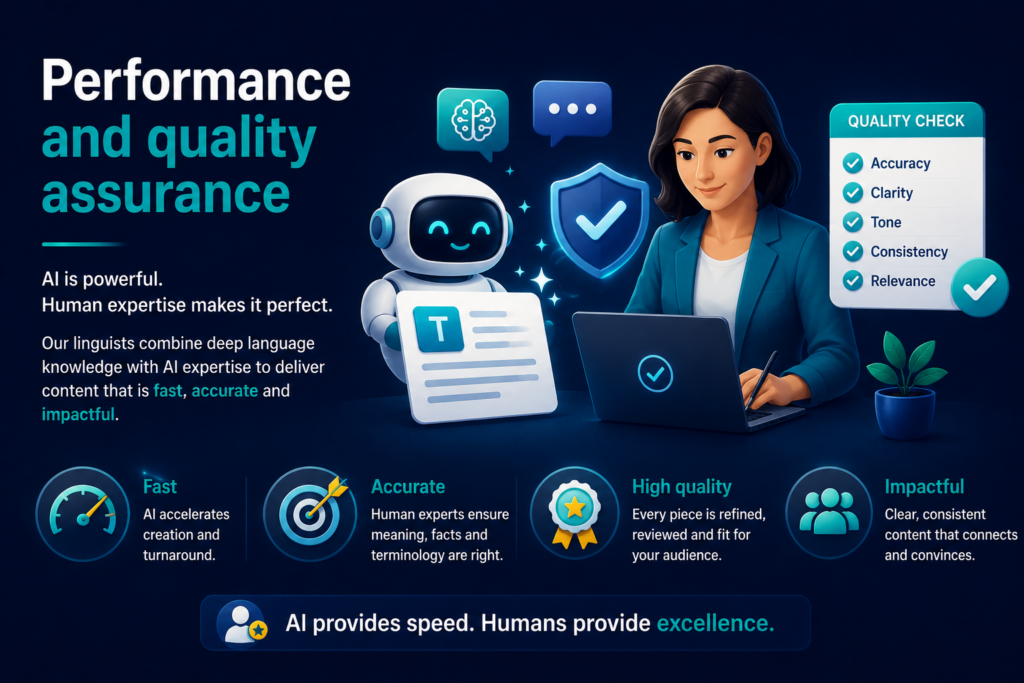
Performance and quality assurance
Quality comes from experience. AI output alone is never enough. That is why AI-assisted content creation relies on professional linguists who understand language deeply and know how to work with AI tools effectively. These specialists combine years of language experience with practical knowledge of AI systems. They know how to guide AI output, recognise weaknesses, and shape content so that it reaches the intended audience clearly and convincingly.
This balance ensures that content is fast to produce, accurate in meaning, and strong in impact.
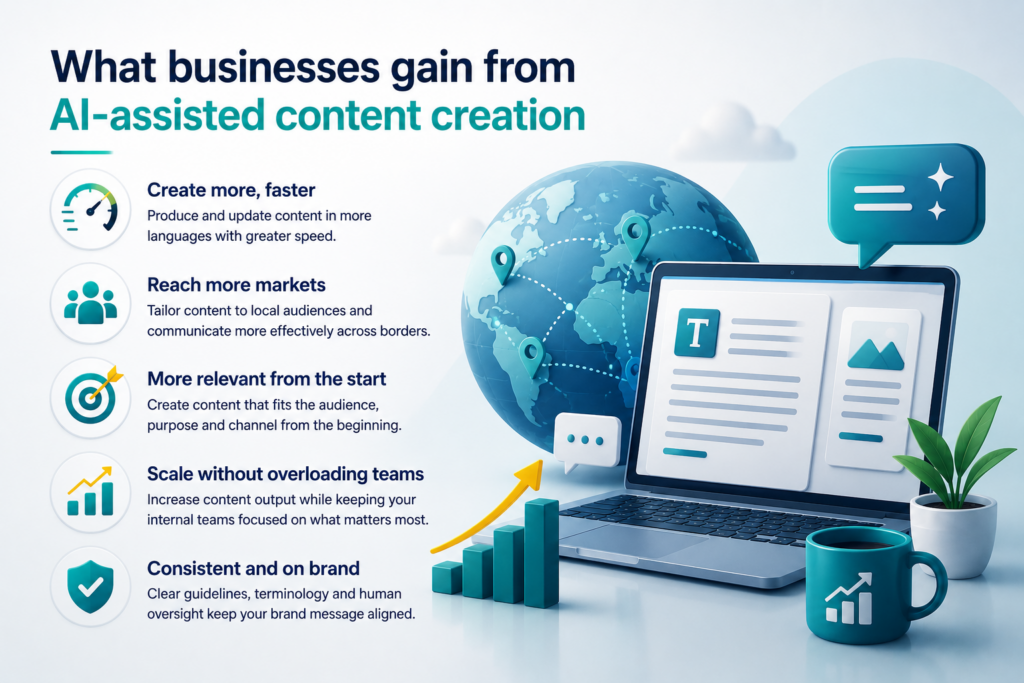
What businesses gain from AI-assisted content creation
AI-assisted content creation allows organizations to create content faster and in more languages, while making it easier to tailor content to the target audience and intended purpose from the start.
It can help teams communicate more clearly across borders, reach new markets more effectively, and increase content production without putting the full workload on internal teams. For organizations without local experts in every market, it provides a practical way to create locally relevant content with support from professional linguists who understand the language, culture and audience.
To maintain a consistent brand message across markets, clear briefings, terminology, style guidelines and human oversight remain essential.
Partner with Attached for AI-assisted content creation
AI-assisted content creation does not stop when AI generates a text. Attached can support the complete process, from creating and improving content to verifying and validating the final output.
Our linguistic and cultural specialists can:
- Create content using secure AI tools and carefully designed prompts
- Improve existing AI-generated content for language, style, tone and local relevance
- Verify content against your briefing, terminology and brand guidelines
- Validate accuracy, meaning and cultural appropriateness before publication
- Incorporate feedback into future content creation processes
This gives you the flexibility to use AI at different stages of your content workflow, while keeping human expertise in the lead where quality, accuracy and cultural relevance matter.


Why choose Attached
- Tailored solutions perfectly aligned with your specific needs and goals.
- A comprehensive service package to support your international growth and communication from A to Z.
- A dedicated team always ready to assist you, combining AI-powered tools with human expertise.
Questions & Answers
Could we not just use ChatGPT ourselves for content creation?
You could, but public AI tools are generic, unsecured, and not tailored to your brand or audience. At Attached, we select the right AI engine (out of 35+) for the task, in a secure environment, guided by professional linguists with local cultural expertise. Human expertise stays in the lead, ensuring accurate, on brand, and fit for purpose content.
Can this replace human copywriters?
No. AI supports human specialists. It does not replace judgement, creativity, or responsibility.
Is my data safe?
Yes. We only work in closed and secure AI environments. Your content is never used to train public models.
Can you match our brand voice?
Yes. Style guides, terminology, and tone are integrated into the process from the start.
Is this suitable for regulated industries?
Yes. Our Human-in-the-lead model and ISO-certified workflows are designed for environments where risk and compliance matter.