
Localization management
Streamline collaboration across all markets.
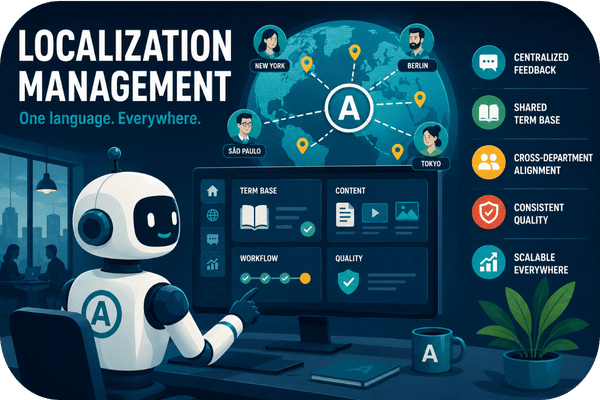
Do you sometimes spend more time aligning translations and managing consistency than working on your actual business priorities? Are different teams and markets pulling content in different directions, while no one truly owns the bigger picture?
Attached helps you take control of localization complexity. We act as a dedicated partner who manages all moving parts of your localization strategy.
What is localization management?
Localization management is the structured handling of multilingual content once translation processes become complex. As more markets, teams and content types are involved, content needs to be translated, reviewed, updated and approved in a coordinated way. Localization management allows you to:
- Maintain agreed terminology choices across all languages
- Keep translation memories aligned with published and approved content
- Coordinate localization across teams, markets and content types
- Document language changes and decision-making
Everything below explains how that works in practice.



When localization management matters
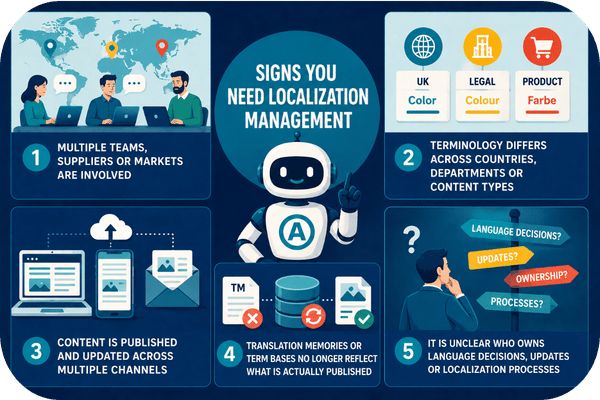
When is localization management important for you? Localization management is relevant for your organisation if:
- Local markets regularly send feedback that conflicts or overlaps
- Multiple teams request changes to the same content
- Terminology differs across countries or departments
- You notice repeated discussions about wording and tone
- Translation memories no longer reflect what is actually published
In these situations, localization management matters because unmanaged feedback creates inconsistency, repeated debates and unnecessary rework. Without structure, every comment risks becoming a change, even when it should not. Localization management introduces clarity by separating preference from necessity and documenting decisions so they do not have to be made again.
What We Deliver
Markets review content from their own perspective, often focusing on local nuance, customer expectations or regulatory context. Without coordination, this feedback quickly becomes fragmented, contradictory or driven by personal preference.
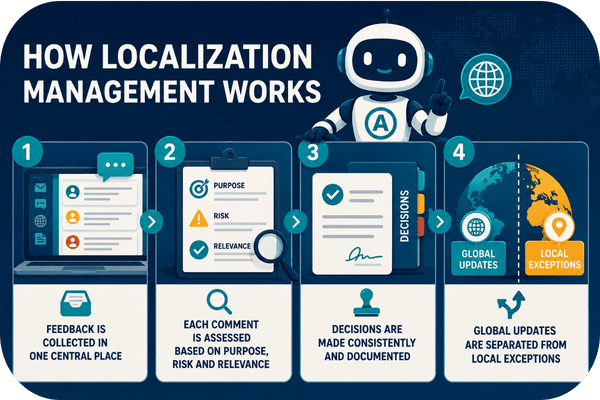
By local marketing coordination, we ensure:
- Feedback is collected in one central place
- Each comment is assessed based on purpose, risk and relevance
- Decisions are made consistently and documented
- Global updates are separated from local exceptions
This approach allows local expertise to be used effectively while protecting consistency and efficiency across all markets.
Translation memory management
Over time, unmanaged translation memories fill up with outdated phrasing, market specific exceptions and terminology that no longer reflects approved content. This leads to confusion, slower translation and declining quality.
We manage your translation memory by:
- Cleaning and maintaining translation memories
- Aligning stored segments with approved content
- Defining what should be reused and what should not
- Preventing outdated content from resurfacing
This keeps translation fast, cost effective and consistent.
Terminology and term base management
Product names, legal concepts and brand language often evolve differently across markets and departments. Without governance, teams create their own versions and inconsistencies can gradually spread across your content.
Attached helps you establish and maintain a clear terminology framework by:
- Creating and managing one shared term base across languages
- Defining clear rules for local adaptation
- Aligning terminology across departments such as marketing, legal and product
- Ensuring agreed terminology is consistently applied in future translations
This reduces recurring discussions, speeds up translation decisions and keeps terminology consistent across markets, teams and content types.
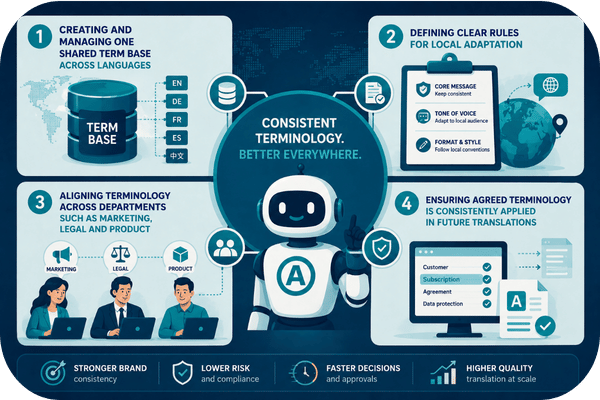
Create consistency across channels and content types
Product names, legal concepts and brand language often evolve differently across markets and departments. Without governance, teams create their own versions and inconsistency spreads quietly.
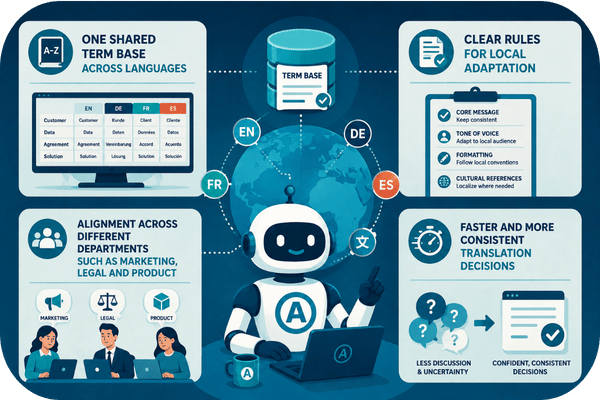
Localization management establishes a clear terminology framework:
- One shared term base across languages
- Clear rules for local adaptation
- Alignment across different departments such as marketing, legal and product
- Faster and more consistent translation decisions
Attached helps establish and maintain your terminology framework and term base, ensuring that agreed terminology is consistently applied across languages, markets and content.
This prevents recurring debates and strengthens clarity across all content.

Why choose Attached for localization management?
- Attached works as a partner with a deep understanding of your brand, content and internal dynamics. We connect all the loose ends in your localization operation and take responsibility for the details that quietly consume time and energy.
- We manage the complexity for you. We document decisions so they do not resurface. We keep translation memories and term bases aligned. We coordinate feedback across markets and channels. This allows your teams to focus on the work they are actually good at, rather than on constant alignment and correction.
- The result is less internal friction, fewer repeated discussions, and more confidence that your content is aligned across every market. Your teams can focus on their real priorities, while we help keep localization under control.







Ready to bring structure to multilingual content?
With Attached, you gain a partner who helps you coordinate feedback, maintain language assets, and keep multilingual content aligned across teams and markets.
Book a consultation today and discover how our Localization Management services can reduce rework, improve consistency, and give your teams more control over multilingual content.
Questions & Answers
What is localization management?
Localization management is the structured coordination of multilingual content across markets, teams and channels. It ensures that translations remain consistent, approved and up to date over time, while managing terminology, translation memories and local market feedback in a controlled way.
When does localization become complex enough to require management?
Localization usually requires management when multiple markets are involved, content is updated frequently, or several teams review and influence language decisions. If consistency becomes hard to maintain or discussions repeat, localization management helps restore clarity and control.
How does localization management improve consistency?
Localization management improves consistency by centralising decisions, managing terminology, aligning reusable language assets, and making sure feedback is handled in a controlled and documented way across markets and channels.
Can you manage feedback from multiple local markets?
Yes. We help collect, assess, prioritise, and document market feedback in a structured way so that local input is considered without creating unnecessary inconsistency or repeated debate.