
AI-engine creation
Build AI around your language, content and brand.
What is an AI engine?
In the context of localization and translation, an AI engine is the system that generates content output. This can be any large language or translation model, such as ChatGPT, DeepL, or Microsoft’s language models (within Copilot). These engines analyse text, learn patterns in language, and generate new content or translations based on that learning.
When we talk about AI engine creation here, we are not referring to generic, publicly available engines. We are talking specifically about customized AI engines. These are AI systems that are tailored to your organization, your content, your terminology, your tone of voice, and your way of communicating. They are built and trained in closed, secure environments, using your own approved data. Your content is not shared, reused, or exposed to public models. This ensures that sensitive information, internal language choices, and brand knowledge remain protected, while delivering AI output that is more consistent, accurate, and fit for your specific purpose.



Custom AI-engine creation for localization
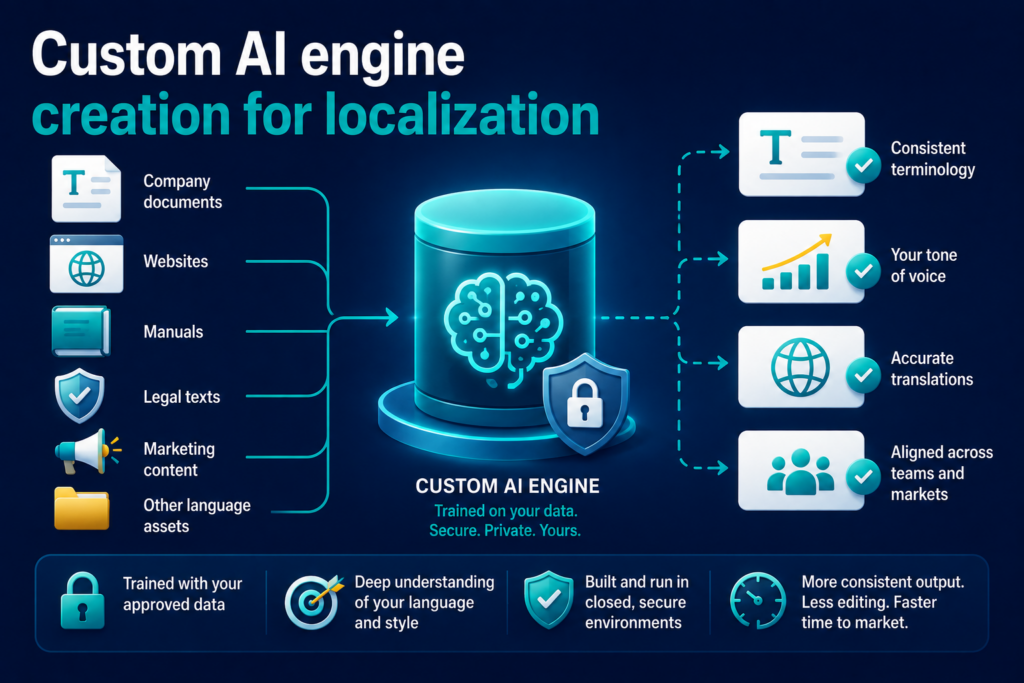
A custom AI-engine is trained with your own materials. These materials can include various sorts of company documents, websites, manuals, legal texts, marketing content, or any other relevant language assets. By analysing large volumes of this data, the engine builds a deep understanding of how your organization communicates, internally and externally. It learns for example what words you use, how you structure sentences, how formal or informal your tone is, and how specific terms should be handled.
To build a reliable custom AI-engine, a minimum amount of data is required. In practice, this means around 5000 to ideally 10,000 segments (~ 50,000 – 100,000 words) of high quality content. The data analysis and training phase typically takes several hours and can extend to a full day, depending on complexity and volume. The result is an AI system that reflects your organization’s language far more accurately than any generic engine ever could.
What can you do with a custom AI-engine?
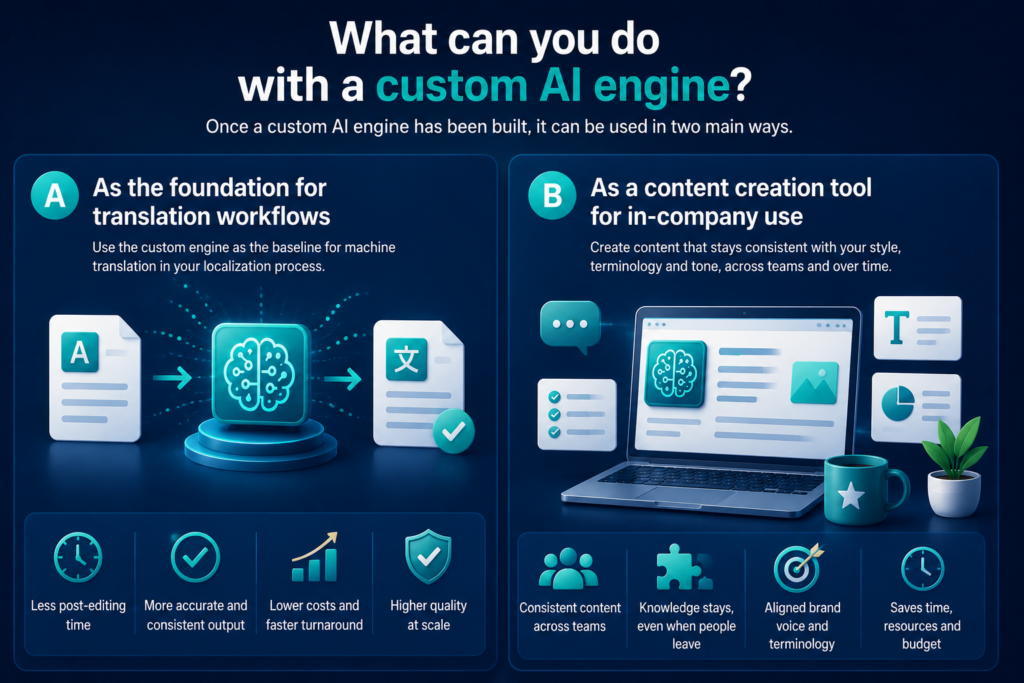
Once a custom AI-engine has been built
- As the foundation for translation workflows
The custom engine can be used as the baseline for machine translation within your localization process. Because the engine ideally has been trained with carefully selected, high-quality data that reflects your terminology and style, the translation output should be significantly more accurate and consistent.
This means less time spent on post editing, fewer corrections, and smoother workflows overall. For recurring content types such as blogs, press releases, manuals, or reports, the engine becomes increasingly precise. In many cases, only a final verification step is required. This reduces translation effort, costs, and turnaround time while maintaining quality.
- As a content creation tool for in-company use
Your organization can also use the custom AI-engine to create content for in-company use. Because the engine understands your style, terminology, and tone, it helps teams write content that stays consistent across departments and over time.
This is especially valuable for organizations with many contributors, frequent updates, or staff changes. The knowledge embedded in the engine remains available even when people leave the company. Content stays aligned, confusion is reduced, and communication remains consistent. Everything is kept in one safe, controlled environment, which saves time, resources, and budget.
Use cases for custom AI-engines
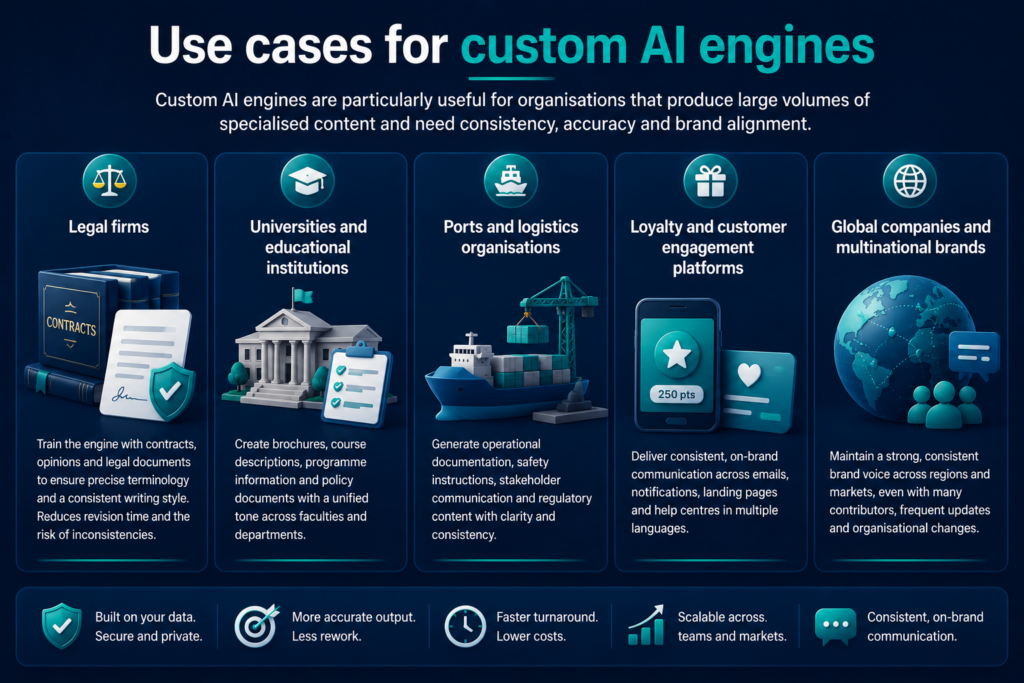
Custom AI-engines are particularly useful for organizations that produce large volumes of specialised content and need consistency, accuracy, and brand alignment.
Legal firms
A legal firm can use a custom AI-engine trained with its own contracts, opinions, and legal documents. This ensures precise terminology and a consistent writing style. Because the output is more accurate from the start, legal teams spend less time revising and post editing, while reducing the risk of inconsistencies.
Universities and educational institutions
Universities can use a custom engine to create brochures, course descriptions, programme information, and policy documents. This helps maintain a unified tone across faculties and departments, even when many people contribute content. It also supports multilingual communication without losing consistency.
Ports and logistics organizations
Organizations such as ports or logistics platforms can use custom engines to generate operational documentation, safety instructions, stakeholder communication, and regulatory content. Consistency is critical in these environments, where clarity and accuracy directly impact operations and compliance.
Loyalty and customer engagement companies
Companies in the loyalty sector often manage large volumes of customer facing content across markets. A custom AI-engine helps ensure that campaigns, programme descriptions, and communications remain on brand, accurate, and aligned across languages and channels.
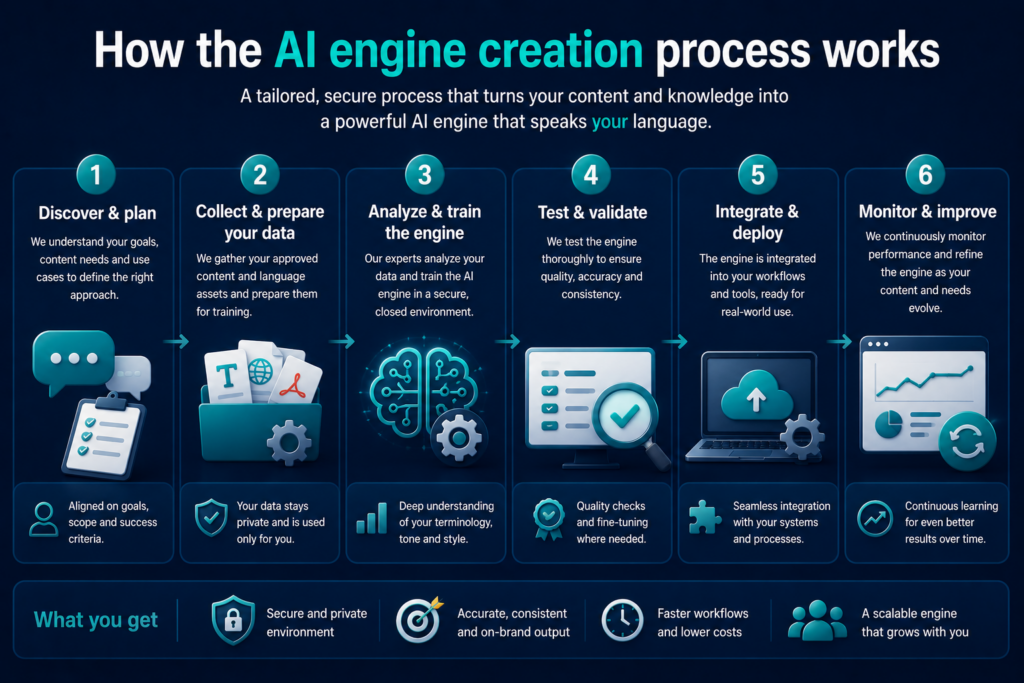
How the AI-engine creation process works
The creation of a custom AI-engine follows a structured process.
- First, we scope your goals. We look at what you want to achieve, what content you have, and what types of content you want to create or translate. Based on this, we assess whether a custom engine is feasible and effective for your organization.
- Next, we gather and organize your data. Relevant content is selected, cleaned, structured, and prepared for training. Quality is essential here, as the engine will reflect the data it learns from.
- The engine is then trained and evaluated. Output is reviewed, performance is measured, and feedback is gathered. Human specialists validate the results to ensure accuracy, consistency, and relevance.
- Once approved, the engine is deployed for use in translation workflows, content creation, or both. After deployment, we continue monitoring performance, collecting feedback, and optimising the engine so it remains up to date and reliable over time.
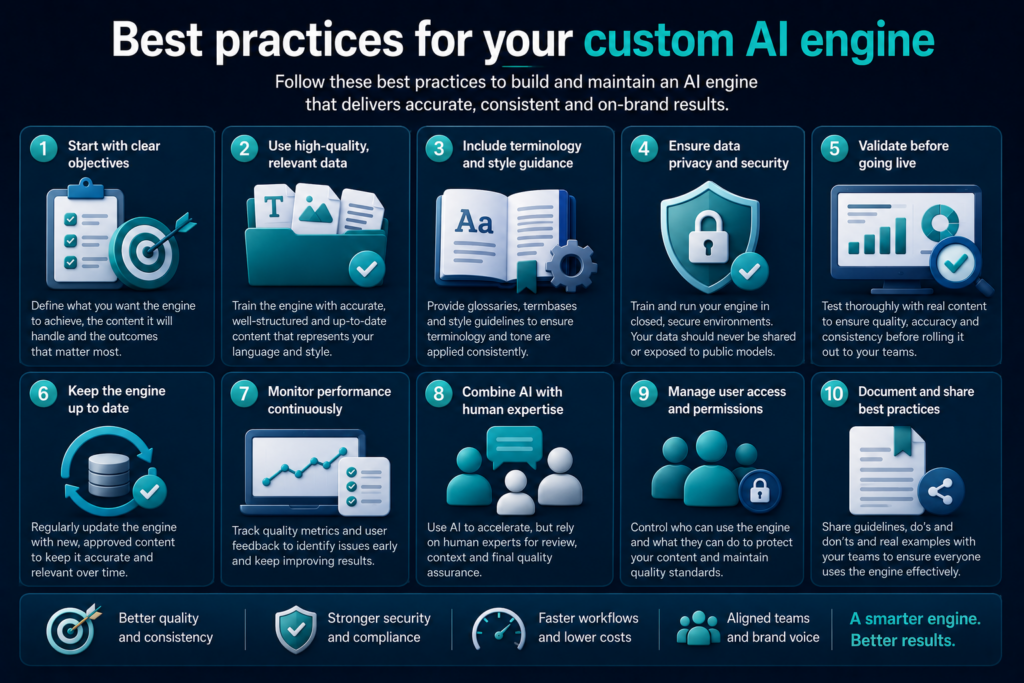
Best practices for custom AI-engines
- Focus on a specific task and audience
A custom AI-engine needs clear boundaries to perform well. Training it on one type of content, for one audience, allows it to learn tone, terminology, and intent more accurately. This results in output that feels consistent, relevant, and usable from the start. - Prioritize high-quality data
The quality of the data determines the quality of the output. Representative, well curated content leads to far better results than large volumes of unstructured data. - Combine AI with human oversight
A custom AI-engine is most effective when used alongside experienced human professionals. Human oversight ensures that tone, intent, and nuance remain correct, especially for specialised or sensitive content.
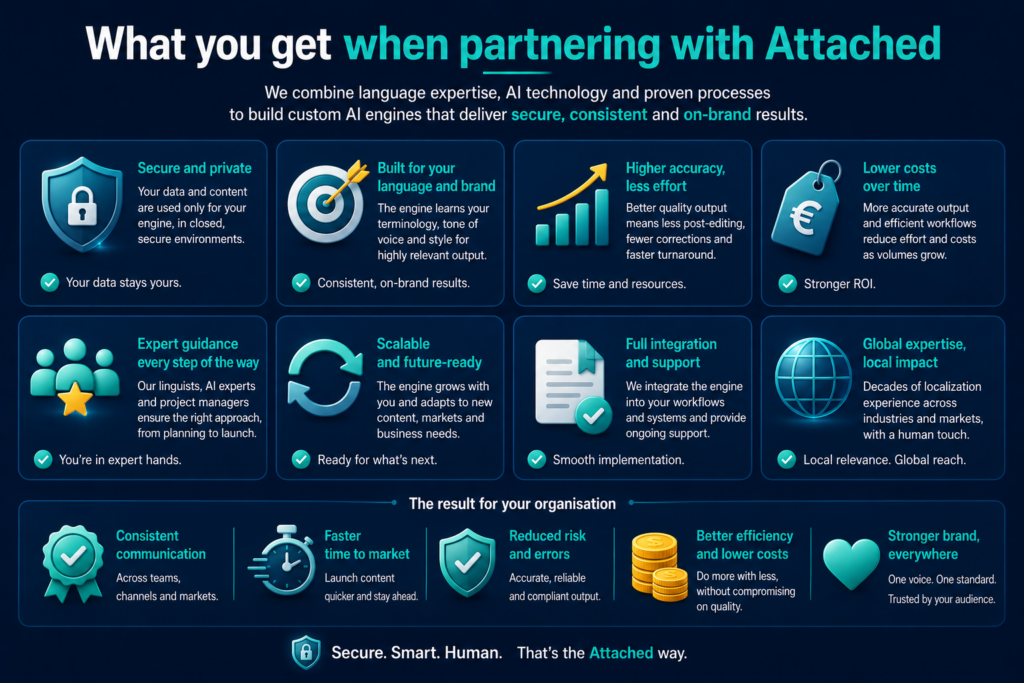
What you get when partnering with Attached
- An AI-engine that understands your language, tone, terminology, style, and brand in depth
- Reduced post editing time and smoother translation workflows
- Reliable AI output for both content creation and translation
- A future proof system with continuous updates to maintain quality and relevance
- A team of linguistic and cultural specialist who monitor, improve, edit or validate AI output when necessary

Ready to build your custom AI-engine?
Partner with Attached and we will guide you through every step, from inventory and training to deployment, evaluation, and long-term maintenance. With Attached, your localization strategy becomes structured, consistent, and built to last.


FAQs on sworn translation
What is the difference between a custom AI engine and tools like ChatGPT?
Public tools like ChatGPT are trained on general data and are designed for broad use. A custom AI engine is trained on your own content, terminology, and style, which makes its output more accurate, consistent, and relevant to your organization.
How much content do we need to create a custom AI engine?
In most cases, a minimum of around 5000 to ideally 10,000 segments (~ 50,000 – 100,000 words) of high-quality content is needed. This can include documents, websites, manuals, contracts, or other existing materials that reflect how your organization communicates.
Can a custom AI engine be used for both translation and content creation?
Yes. A custom AI engine can support translation workflows by improving machine translation quality, and it can also be used internally to create new content that follows your terminology and tone of voice.
Is a custom AI engine suitable for small or medium sized organizations?
It depends on your content volume and use cases. Organizations that produce recurring or specialised content often benefit most. During the scoping phase, we assess whether a custom engine is effective and worthwhile for your situation.
How long does it take to build a custom AI engine?
The initial analysis and training typically take several hours up to a full day, depending on the volume and complexity of the data. Additional time is spent on evaluation, validation, and fine tuning before deployment.
Does the AI engine replace human translators or writers?
No. The engine supports human professionals by improving efficiency and consistency. Human oversight remains essential to ensure accuracy, intent, and quality, especially for specialised or sensitive content.
How do you ensure the AI engine stays accurate over time?
We monitor performance continuously and update the engine with new content, feedback, and terminology changes. This ensures the system remains aligned with your organization as language and content evolve.
Is our data safe when training a custom AI engine?
Yes. Custom AI engines are built in controlled environments using your data only for your system. Your content is not used to train public models or shared with third parties.
What types of organizations benefit most from custom AI engines?
Organizations with recurring content, specialised terminology, or high consistency requirements benefit most. This includes legal firms, universities, logistics organizations, public bodies, and companies in regulated or customer facing sectors.
How do we know if a custom AI engine is the right solution for us?
We start with a scoping phase to understand your goals, content, and workflows. Based on that assessment, we advise whether a custom AI engine is the right approach or whether another solution would be more effective.
Why choose Attached
- Tailored solutions perfectly aligned with your specific needs and goals.
- A comprehensive service package to support your international growth and communication from A to Z.
- A dedicated team always ready to assist you, combining AI-powered tools with human expertise.